Based on a Story | Tamar Lev-On
Based on a Story | Tamar Lev-On
Tamar Lev-On | Based on a Story
Over the last ten years, Tamar Lev-On read hundreds of popular legends and “bedtime stories” originating from Wadi Ara. She created tables in the form of a visual original text or modern hieroglyphs, depicting animals, occupations, punishments. Concluding her research, she decided to focus on one story: “Cheese (Jbene)”. This is a local but generic story that resembles others known from around the world, albeit with different titles and plots.
Jbene is a local story that envisions a royal realm within Wadi Ara’s rural landscape. The legend tells the story of a young girl who set out with her maid to meet her groom, the prince, but the maid deceived her by taking her horse and her clothes and blackening her white face. The maid coated her own face with white dust and thus, having switched their identities, misled the prince, who married her. The birds and animals, however, came to the assistance of Jbene, as nature knows no wrong, and all ended well.
The exhibition, however, centers not on the story itself or its narrative twists , but rather on the discrepancies revealed upon conveying the translated story. In the artist’s words, this is because “Initially I understand that I am in fact not encountering the original story – it is not accessible to me in its original form, but rather only in a mediated form”.
Throughout her practice, Lev-On juggles between worlds of fiction, reality and folklore. She gives life to found or made up identities, using the diverse tools she gained over the years.
Regarding the mediation question, which is the heart of the exhibition, Lev-On operated as a one-person multi-disciplinary team. She created an exhibition that is split into several spaces and utilizes elements from installation art and theatre. The exhibition includes a sculpture installation constituting a three-channel sound anchor produced via digital technology, as well as a video art piece, combining illustration and animation.
The introduction to all these is a framed array of drawings and photographs: the entrance space to the exhibition addresses the hybrid merging of human with animal, animal with human. Human skeletons merge into magazine photographs of animals, and sometimes the human skeleton assumes a new form within the existing contours, using the animal as a hiding place or a disguise.
Human and animal take each other’s form, as in another version of the story where Jbene becomes a dog who can transform herself unseen.
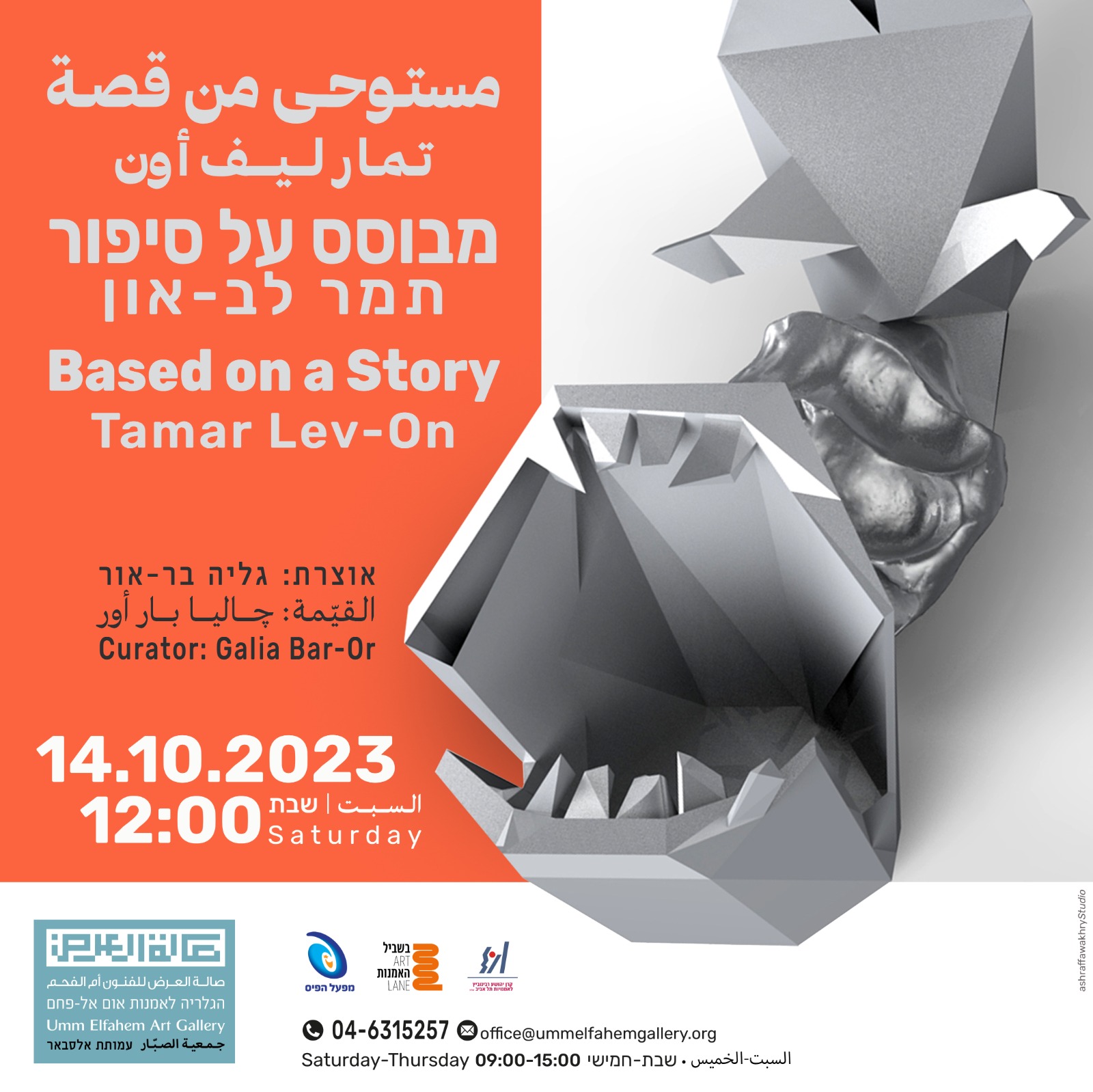
Jbene sings a song that calls upon the flying birds, which became the soundtrack of the exhibition and the sound anchor that emanates from the space adjacent to the entrance hall. This is a computerized sound that lacks the identity of a human voice, age, gender, or ethnic origin. The song’s lyrics and harmony were typed as a computerized database, and the singing was produced with digital means alone. The sounds emanate from sculpted objects – three undefined 3-dimensional printed animals welded from animals’ parts.
The loudspeakers are positioned within the animal sculptures installed in the room, and together seem like a strange alien hybrid piece of jewelry. Also strange is the discrepancy between the cold geometric shapes and the human presence in the form of the artist’s hands, embossed into portions of the sculptures: “I impressed my hands in lumps of clay, the lumps underwent 3-dimensional scanning and became a digital file that was connected to the bodies of the animals – and then returned to the real world through 3-dimensional printing”.
Lev-On sculpted and drew, translated, rhymed, sang and created video art that features her own character. She planned and conceptualized the entire course of action, with the participation of Itamar Ziegler, in charge of the music and recording, Oded Essner, responsible for the digital sound, and narrator Loaay Wattad.
In the facing space the main work is displayed: the video piece “Rhymes / Beads”, an invitation to listen to a story. This is a two-channel video piece, presenting a bilingual narration of the plot, told in Arabic and translated and read in Hebrew rhymes, which reveals cultural discrepancies, small contradictions resulting from semantic disagreements, translation issues, differences in interpretation, and so on.
The entire exhibition was created as a whole by a single artist, but everything in it is called into question, even the title of the legend underlying the exhibition: “Cheese” (Jbene in Arabic). Indeed, Jebne is the name of a character in the story, and like Cinderella it is a name that is not used in the real world for those born in the villages of Wadi Ara and in Umm El-Fahem, rather a literary name used as a brand – for example, for the “Jbeneh” theatre, with its branches in Jerusalem, Nazareth, and Haifa.
Lev-On chose “Jbene” also because she fell in love with the name, the sound, the unknown worlds it aroused within her. Let’s listen to the sound of the name, and perhaps we’ll rethink the need to change it, which is a good point of departure.
Galia Bar-Or, Curator


