I Could Only Tell by My Nose | Group Exhibition
I Could Only Tell by My Nose | Group Exhibition
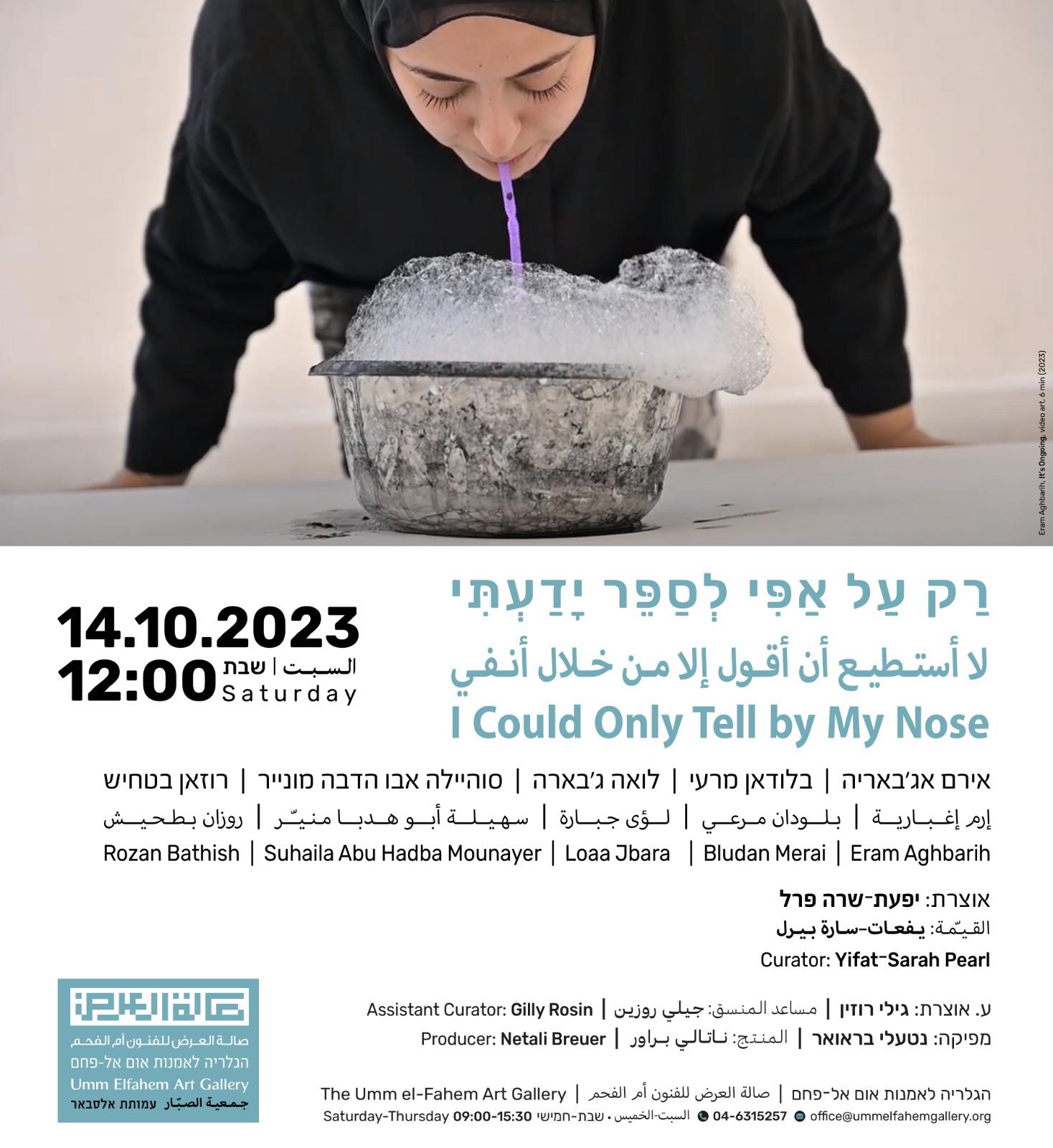
I Could Only Tell by My Nose
Scents can be a powerful tool for engaging with history on an emotional level. They evoke memories, emotions and experiences that connect us to our past, environment and culture. However, scents are not recognized as part of our intangible cultural heritage by UNESCO, and the olfactory world is underrepresented and almost entirely undocumented.
When we talk about identity, we start sniffing around, bringing up images from our past, family stories and written histories. Not only does reconnecting with our community’s heritage and identity help us remember and document the past — it also helps us understand our present and how it connects to the history we share.
I Could Only Tell by My Nose comprises five solo exhibitions born out of Wadi, an art incubator for promoting young female artists from Arab society, initiated by the Umm el-Fahem Art Gallery. Among the participants are Christian, Muslim and Druze. Each artist chose to tell the emotional story of her community’s heritage and identity through scents and memories. The challenge was to utilize the sense of smell as a starting point for telling the story. How can the ancient scents associated with places, customs and texts help point the way to our cultural identity?
Art has the power to reveal and preserve the scents that surround us in our day-to-day. Sada coffee, salt and charcoal, za’atar, goat’s milk, tar, smoke, and Bakhoor incense and even soap — all of these are scents that the artists chose to use as artistic media to tell their stories of Arab society’s culture and identity.
Rozan Bathish incorporates coffee fingerprints into emotionally charged abstract paintings that delve into her inner self, inspired by her grandfather’s traditional ritual of sada coffee preparation. Eram Aghbarih’s solo exhibition focuses on the dynamic relationship between her childhood memories — stained by recurring experiences of violence on her way home from school — to the familiar scent of liquid dish soap used for domestic hygiene. Suhaila Abu Hadba Mounayer reconstructs the sea breeze smell to express her longing for her grandmother’s house in Jaffa — a house she has seen only in her family’s photo archive. She does this with salt-cast curtains and lamps engraved into charcoal-cast elements, representing a specific lamp that has traveled with the family over the years. and the taste of her za’atar is her signature mark. Bludan Merai crosses boundaries with scents. Identifying the smell of a traumatic event that her father experienced as a young boy helps her communicate and recount the event. Loaa Tamim Jbara uses her fiancé’s work — repaving roads — as a metaphor for couples’ engagement period in Arab society. The smell of steam, the boundaries and the roads that separate the spouses-to-be also pave the way toward their upcoming union and shared future.
Five young female artists explore the functions of scent beyond its practicality. By extracting smells from their family and community archives, they have created scent-based artworks that help us imagine and pass down stories and crafts. They spotlight traditions, languages, idioms and folktales, all of which are part of the intangible heritage that has shaped the identity of our present-day society.
Join us on a fascinating and challenging journey into the sensory space between the eye that sees the object and the scents visible within it, scents that inspire both personal and collective narratives.
Yifat-Sarah Pearl, Curator
Still Light
Suhaila Abu Hadba Mounayer
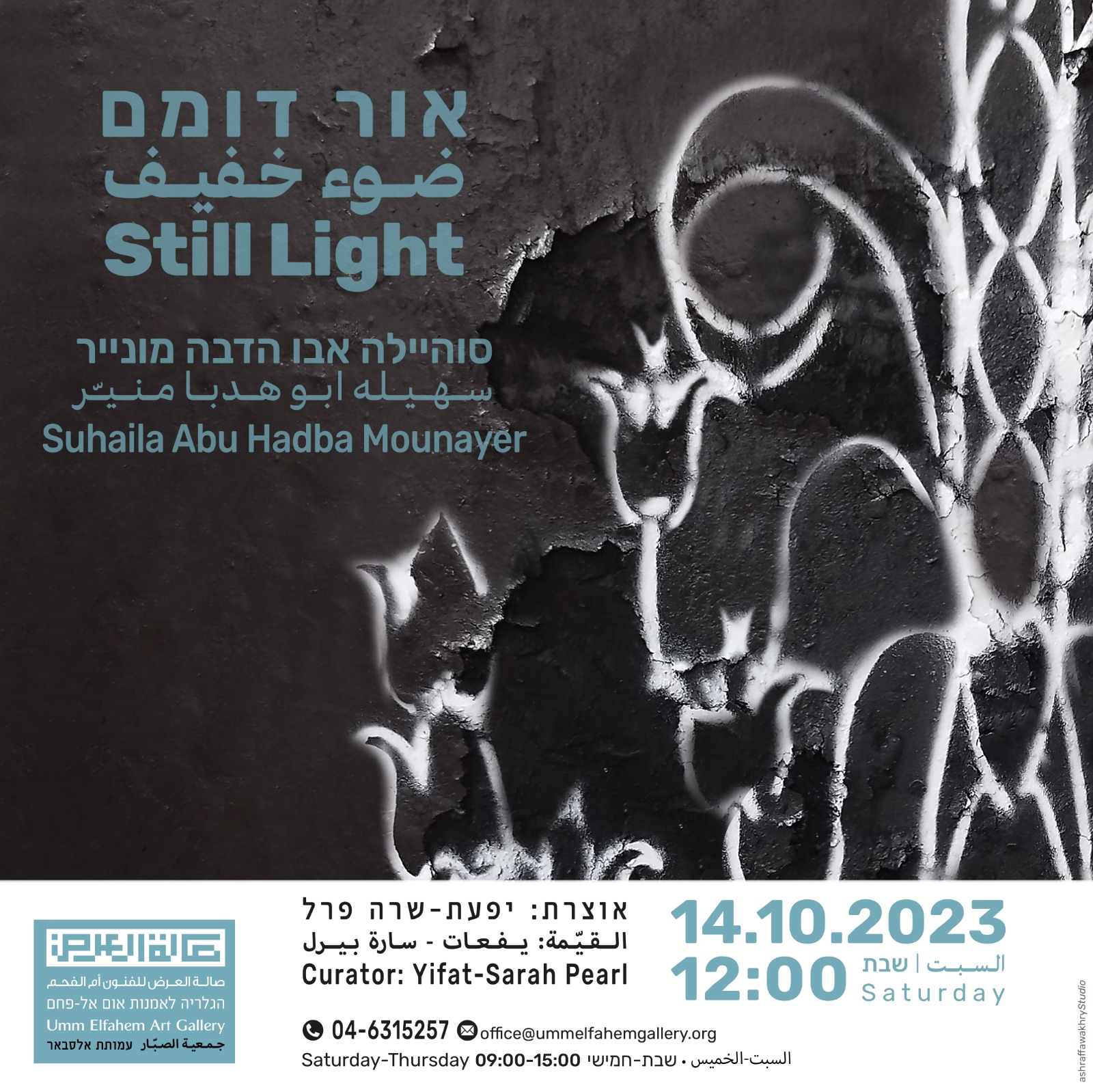
Suhaila Abu Hadba Mounayer uses her family’s photo archive and items from her grandmother’s house to reconstruct memories from her family’s big house in Jaffa — her grandmother’s childhood home, where she lived from 1938 to 1945, the year she got married. Abu Hadba Mounayer has never been to this house. It has since changed beyond recognition, and her family no longer owns it. However, its presence is still felt strongly in the items the family has kept in its possession, and the family’s stories about the house have left an indelible mark on her.
In this exhibition, Abu Hadba Mounayer uses memories from her family’s archive as if they were her own. By engaging with images and materials of and from the house, she transforms her family’s collective memory into a personal one, as if she were there, in the house.
The primary materials used in this exhibition are charcoal and salt. The two materials, black and white, are primarily used to recreate the pattern of the checkerboard floor in the Jaffa house. Family photos are then embedded into this pattern, reminiscent of a documentary.
The charcoal symbolizes the light and the special connection between Abu Hadba Mounayer and her grandmother, who shares her first name, Suhaila, meaning Venus, the bright star-like planet that shines in the sun’s rays. The artist explains that her grandmother would light a candle whenever she expected good tidings. The significance of light in their lives is articulated in a triptych depicting a lamp as seen in photographs from the old Jaffa house and again as it appears today in her grandmother’s house in Lod. Etched in her memory, her grandmother’s stories inspired paintings with images engraved on charcoal and oil paint on wood.
The smell of the sea breeze that filled the Jaffa house is a powerful element in the memory the artist wishes to preserve. In a site-specific installation titled “I Can See It Through My Window,” Abu Hadba Mounayer used ten kilograms of salt on chiffon fabric to express the sensory experience of the sea breeze and light that came into the Jaffa house through the window.
Suhaila Abu Hadba Mounayer (b.2001), fourth-year student in the Department of Fine Arts at Bezalel Academy of Arts and Design, Jerusalem.
She and He
Loaa Jbara
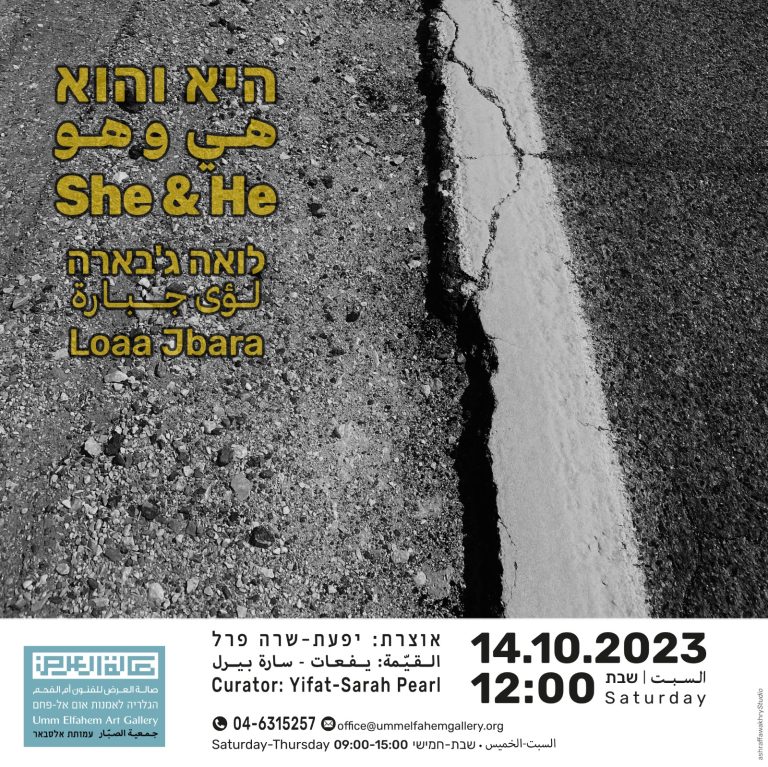
The exhibition “She and He” explores the relationships of engaged couples in Arab society. Loaa Jbara depicts the connections and boundaries between spouses-to-be through the measurement and marking of roads — her fiancé’s line of work. She is from Taybeh. He is from Jerusalem. Each item in the exhibition symbolizes a different aspect related to the couple’s engagement period, with the roads connecting them and paving the way for their shared future.
Metaphor is a powerful tool for understanding new concepts. It enables us to structure one concept in terms of another to better understand the world around us (Lakoff and Johnson, 1980). By conceptualizing the deepening relationship and the anticipated changes in her and her fiancé’s lives in terms of road work — measurement, paving, and milling — Jbara gets to know her partner and learns to understand the new connection forming between the two of them.
The road photographs reveal the layered structure of a road — surface layers and deeper layers. Two pieces of road represent the wedding rings and the budding relationship between the spouses-to-be. The yellow line on the photographs symbolizes the boundaries and restrictions that exist both on the roads and in the customs of engagement and marriage.
The smell of tar and asphalt is preserved in small jars containing dust from pavement milling works. The jars themselves resemble Bakhoor incense — traditionally used at weddings — or the “scent bombs” used to freshen young couples’ new homes. Each jar is labeled with a printed love poem traditionally heard at weddings and celebrations. To tie the metaphor together, Jbara incorporates the items into a collage with traditional embroidery that depicts Palestinian wedding customs.
Loaa Jbara (b. 2000), Bachelor’s degree in the Department of Arts – Hamidrasha, Beit Berl College
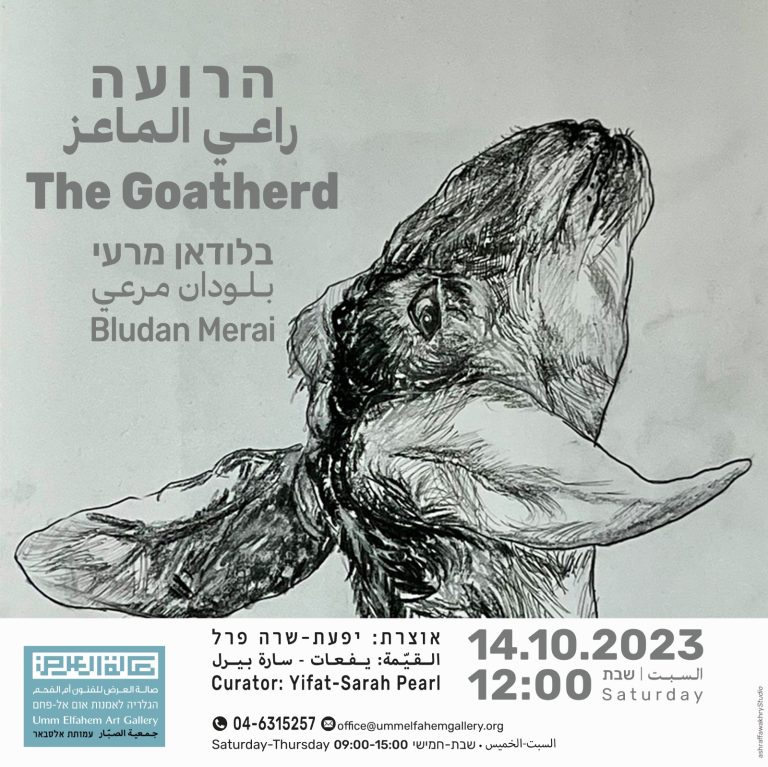
The Goatherd
Bludan Merai
Bludan Merai was born into a Druze family in the Golan Heights. Originally from Syria, her family found itself in Israel after the Six-Day War. Her father never went to school (and so remained illiterate), instead staying home to help with the family’s livelihood and take care of their goat herd. When he was 14, he was herding the goats with his younger brother when one of the goats stepped on a landmine. He and his brother were severely injured in the explosion and hospitalized for a long time. The psychological trauma was no less severe. The artist’s father lives with PTSD to this day.
Like her father, Merai also grew up with the family’s goat herd, tending to the goats and taking them out to graze alongside her brother. In her current exhibition, Merai engages with her and her father’s goat-herding childhoods through the olfactory sense.
The black charcoal graffiti wall “Son of Al-Khaimah” is a collaboration between Merai and her father — a product of their healing, creative bond. Al-Khaimah was the place where her father took the goats to graze. As two goatherds who share an inter-generational connection, father and daughter stand side by side, eyes closed, reliving the father’s traumatic, painful memory of the place. By remembering and distorting smells, they etch words: the smell of pain, the smell of blood, the smell of dust.
Merai shows this process of letting go of pain and trauma in two video artworks: “Cease Fire,” in which she describes goatskin tanning, a process in which the skins are scraped and scrubbed over and over to remove leftover meat and fat and get rid of their characteristic odor; and “Without Prayer,” in which Merai washes her father’s work clothes in goat’s milk. The milk is white and pure, but it does not clean the clothes. Their sharp animal smell contrasts with the fresh and clean scent of laundry. Merai seeks to erase the trauma by washing it away.
In a series of goat herd portraits (charcoal, pencil, and black pen), the goats appear pierced by our gaze. They are seen from memory, from the place where they were raised. They bear silent witness to the story of the artist’s father’s life, revealing the trauma, the pain and the healing.
Bludan Merai (b. 1999), Bachelor’s degree in the Department of Arts, Oranim College.
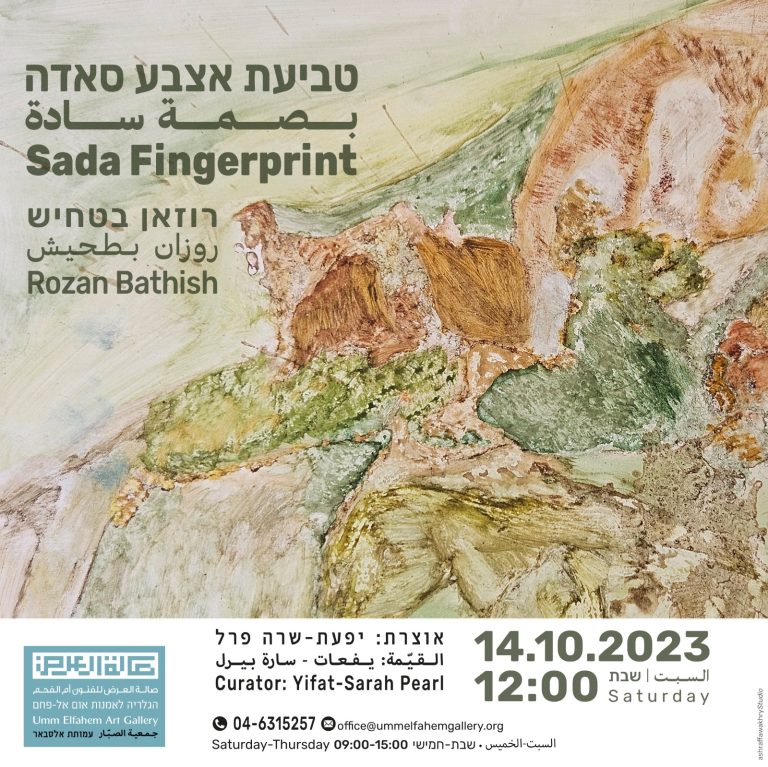
Sada Fingerprint
Rozan Bathish
Rozan Bathish’s series of abstract paintings unfolds before us in colorful layers of delicate and translucent brush strokes, with random shapes and lines that lead the viewer to oscillate between the emotional and the intellectual, between order and chaos, between softness and rigidity.
Bathish, an early-career artist who has recently become a mother, completed her graduate studies in art therapy. She says that her studies have given her new insight into the power of art to touch us, intervene in our lives, and even change us for the better.
In this exhibition, Bathish presents, for the first time, a series of abstract paintings which, when taken together, serve as a map for navigating the new space of the artist’s life.
Bathish paints without planning or thinking; she “spends time within the painting.” The act of painting facilitates the artist’s understanding of her own experience as she transitions into a new environment. Her time within the paintings begins with applying the first layer of sada coffee, bitter and unsweetened. The sada fingerprints serve as the foundation for a neutral visual language, allowing her to add layers of color intuitively and spontaneously. The result is a colorful and optimistic image — much like her life at this time of new beginnings.
Smell is a fascinating dimension that enriches the sensory experience. The smell of coffee dominates her paintings, which depict floral motifs. The artist’s grandfather was in charge of making sada coffee, a traditional ritual that takes several hours. In Arab society, sada coffee is served on special occasions and in times of mourning.
Bathish commemorates her grandfather and explores her grief after losing him in her painting “Grandpa’s Window,” which reflects the idyllic view from her grandfather’s sickbed window, where he spent the final five years of his life. The painting was inspired by the coffee fingerprints. The scents, tastes, and emotions brought back memories that lit up her senses and helped her dive deeper into the painting.
Rozan Bathish (b. 1995), A master’s degree in art therapy, Tel Hai College and a bachelor’s degree in art and teaching, Oranim College
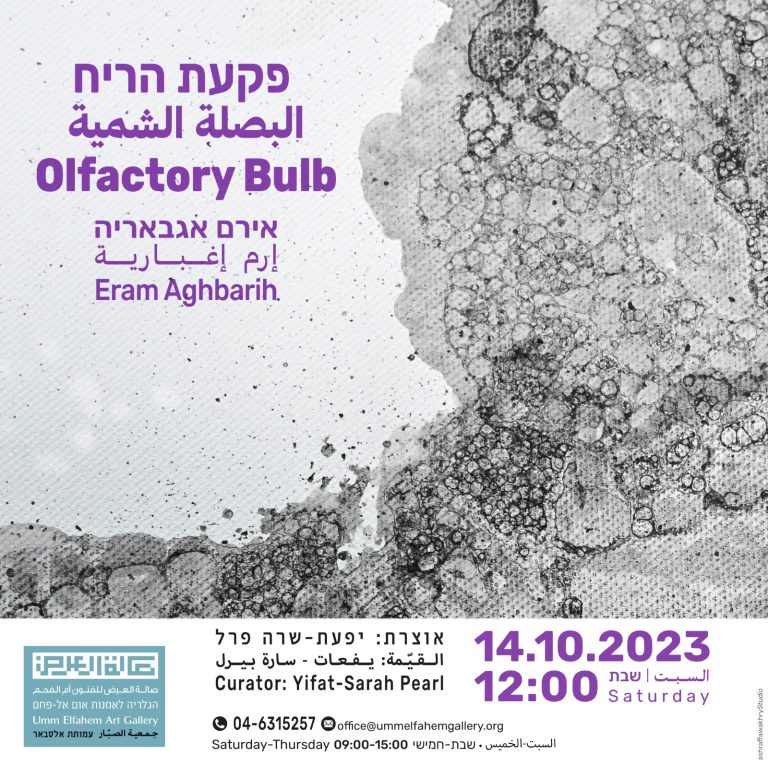
Olfactory Bulb
Eram Aghbarih
Eram Aghbarih’s solo exhibition focuses on the dynamic relationship between her childhood memories — stained by recurring experiences of violence on her way home from school — to the familiar scent of liquid dish soap used for domestic hygiene. This exhibition examines the fascinating rematch between these memories and the functional object — soap. The liquid soap cleans everything, like magic, but is subverted by the act of exhalation by Aghbarih. In a unique artistic process that involves blowing soap bubbles through a straw, Aghbarih blows soap bubbles that spill and blend into the black surface of the canvas. As the bubbles dry, the black color also soaks in and creates a simplified form, and the bubbles themselves paint a picture.
Art has the power to evoke memories and emotions, much like the olfactory bulb, the part of the brain that is responsible for initial processing, that allows us to identify a vast range of smells. The interaction with the soap bubbles is essentially that first interaction with the scent, which the artist processes as a raw material for painting, using it to navigate her experiences through her art in search of a feeling of security.
In the same way as artists use colors, forms and textures to infuse meaning, so Aghbarih’s olfactory bulb takes her back to places and times in which she experienced childhood trauma, through the associations with the smell of dish soap. This is a multi-sensory experience that combines the visual and olfactory senses. The surface as a space allows for moments with rules of their own — rules that determine its form. This process of creation raises questions of uncertainty and control and cultivates a sense of expectation and inquisitiveness.
Aghbarih’s work begins with a clear starting point yet is left open-ended. This ambiguity provokes a powerful emotional response from viewers of the art, that prevents them from connecting with the depth of the pieces and engages not only the sense of sight, but also their own individual emotions and memories.
Eram Aghbarih (b. 2000), Bachelor’ degree in the Department of Arts – Hamidrasha, Beit Berl College


