Between the spheres | Nirvana Assadi Dabbah
Between the spheres | Nirvana Assadi Dabbah
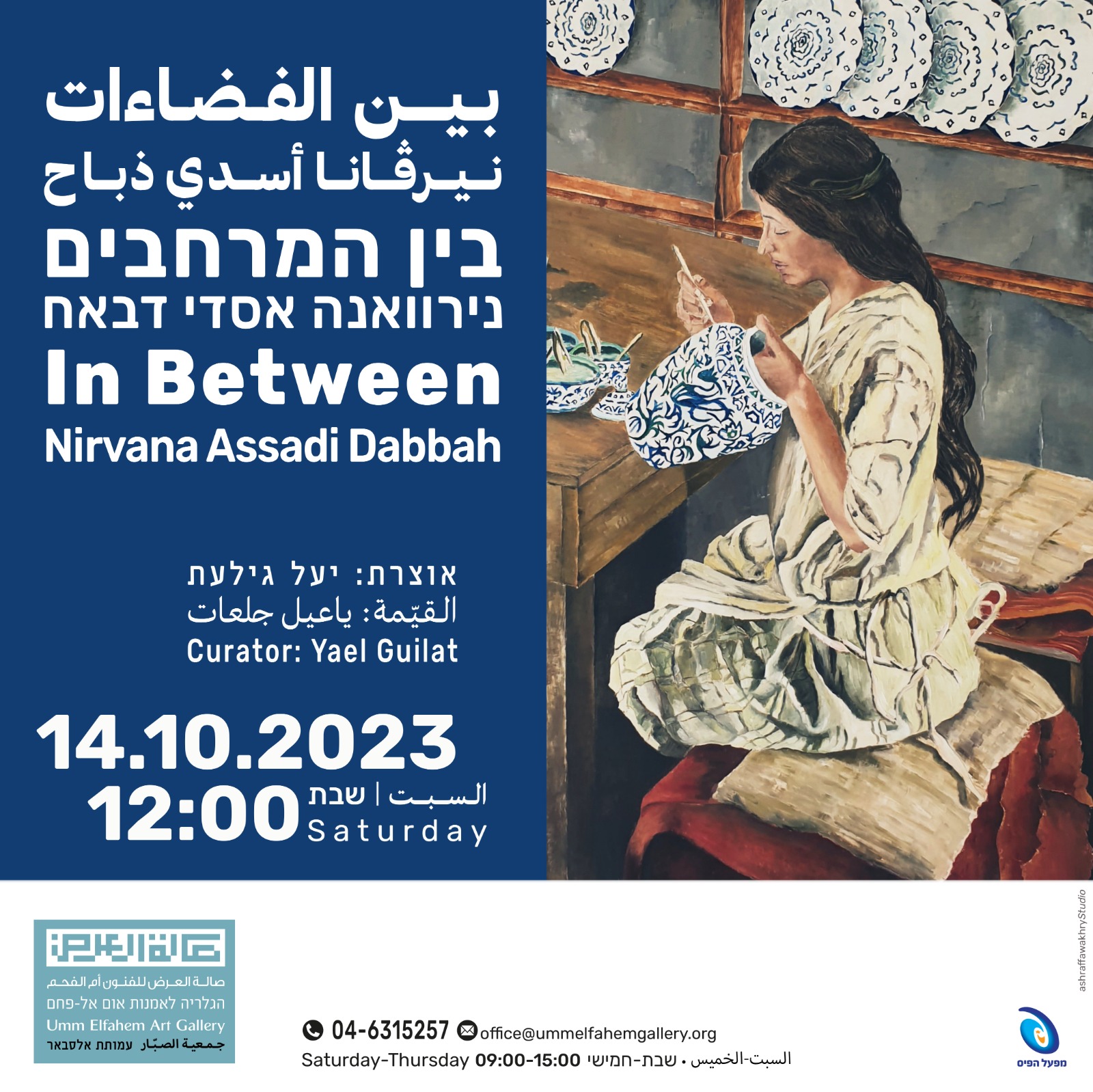
Between the spheres – Nirvana Assadi Dabbah
The two surnames of Nirvana Assadi Dabbah epitomize personal and familial aspects that relate the wider story of a collective and help understand her overall artistic work in recent years – years of intensive creativity, studies, teaching, and display.
Assadi Dabbah is a third-generation descendant of families that migrated from rural to urban areas, returned to the village and then once again to the city, while always maintaining a link with their original community. But these moves did not eliminate the urban habitus acquired even prior to 1948 – a habitus that became an important component in establishing the personal identity and constructing the gender identity of the generations of women born in the city, who strove for equality and independence rooted in education. This was also the origins of the rich cultural foundation of her work, through the unmediated and theoretical-scholarly process of familiarization with cultures, languages, and religions that share the Mediterranean space. It may be said that she was raised in a type of Levantine bubble, which continues to live within her as an aspiration and a value even after it burst during the Intifada in 2000.
Assadi Dabbah began to operate in the art field as a married artist, a mother of three residing in the town of Deir al-Asad with its traditional features, where she moved from her childhood urban environment. All these create an unusual artistic profile within the field of the arts. These unique conditions were the foundation for a singular repertoire of images reflecting present and past, the real and the imagined. After 15 years in Deir al-Asad, the Dabbah family decided to move to Acre. The family’s relocation to Assadi Dabbah’s city of birth intensified the sense of migrating between psychological, historical, and landscape spheres. These moves create connections, partings, and longing that enhance the basic trauma underlying Assadi Dabbah’s sensation of exclusion and alienation that has accompanied her for many years, with her art serving as a “knowing witness”.
Women occupy most of Assadi Dabbah’s paintings and sketches. They engage in handicrafts, rest, reading, and praying. Their position as main characters illuminates the place, and sometimes they themselves become the place and create it as a glorious mosaic of voices, colors, and textures. The women in her works portray a diverse gallery of ages and occupations. Similar to her own biographical profile, they too move between spheres and reflect transitions from the rural to the urban and from mundane and everyday spheres to spiritual spheres. Endeavoring to follow their many years of covert dialogue is a fascinating undertaking, where the figures, as skilled actors, have a role in a story or play with a developing narrative. The spectrum of identities reflected by these women make it possible to discern that each of them contains an aspect with which the artist can identify, and her many varied identifications create an inner sphere of liberty. Where social reality denotes boundaries, sometimes stiflingly so, art creates a world.
Curator: Yael Guilat


