Beyond Time | Lea Dayan
Beyond Time | Lea Dayan
Lea Dayan | Beyond Time
One of the most fascinating issues that has sparked a discussion from the beginning of civilization is the question of what is beyond time and what is within it. What is time and its role in the human experience, and what is its meaning manifested in time itself and in our human ability to comprehend it? These issues are manifested in Lea Dayan’s new sculpture series exhibited at the Umm El-Fahem Art Gallery.
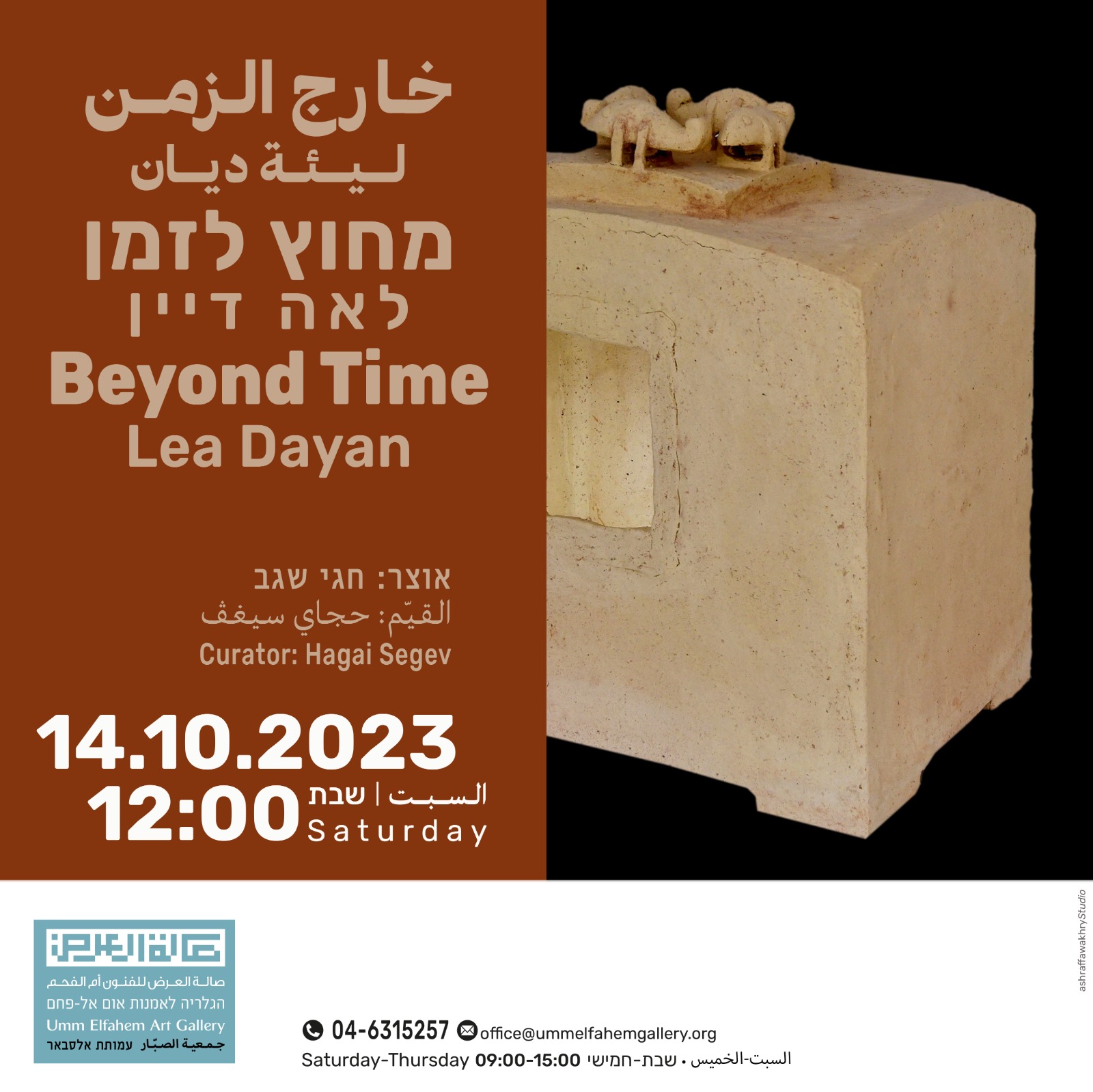
Metaphorical death as well as actual death, residing in structures that traditionally represent the container made for human bones, are a representation that is beyond human time, since time continues for eternity and remains beyond human grasp. Dayan’s sculpture construction with the soft clay is the creation of a realization or emerging knowledge of death – a knowledge that arises and derives from an existential or religious belief regarding the ending of life.
The container and its contents represent eternity, the endless, all-consuming, unknown black world. Therefore, entering the spaces of these death containers represents a move from the light outside to absolute darkness; a consuming space that surrounds the gaze and offers it no way of progress or, alternately, no consolation. Beyond this threshold is a completely black space, where the focused gaze becomes lost, as it is unable to focus on any mark or sign but rather only to withdraw into itself.
The ossuary sculptures resemble miniature religious architecture. Religious structures played a significant role in the development of artistic expression and in its consolidation throughout generations of humans confronting the most terrible and the unknown – death. These structures, such as mosques, synagogues, churches, and temples, are ritual edifices for observation of the religious precepts, aimed at preserving human remnants side by side with serving as a major cultural manifestation – preserving memory for eternity. They themselves are also spectacular and fascinating works of architecture and art.
Dayan is attracted to religious architecture and temples, particularly those that represent sentiments that are beyond time and space. Precisely within the mysterious, incompletely defined place, with its ritual and mythical aspects, we can find an essential understanding of the mystery of life. Dayan designs these structures as monolithic architecture, almost as a complete block but decorated with elements of symbolism. Often, however, it is difficult to define their full identity distinctly. They convey a type of uniformity and wholeness that wants particularity, intentionally so.
Dayan’s sense of inquisitiveness drives her to decipher the secret embodied in the ritual architecture. A vast scope of knowledge exists, accumulated over the centuries, on the meaning of these structures. Nonetheless, psychologically, and spiritually they still constitute a domain that is not fully grasped, since it is beyond time. The secret of form, matter, and particularly spirit, is an endless ground for artistic inquiry.
The study of forms, feelings, desires, and passions reflects the entire human experience for Dayan. This experience is built gradually, and shaped by the artist. Initiating the foundation of the artwork is for her a journey toward the unknown. The foundation is formed through a dialogue between the hands and the clay, which stimulates her to proceed to the next stage, the next representation. The process of building the sculpture is a type of meditative process in which she is immersed.
Dayan finds pleasure in the repetitiveness, as well as in the infinitesimal shifts or additions that time and again change the outward appearance and allow endless variations on a single topic. Although the series seems identical, each piece changes with the nuances, the structuralism of the sculpture, the technique, or the location of the unique elements of each representation.
The coarse earthen materials strongly contrast with the delicate treatment of the specific elements that define the sculpture’s structure. Nuances are gradually formed with the shaping of openings, decorations, or figures of animals. Dayan is attracted to the rough contrast between the mass and the fine processing of the details. These nuances help us understand the story within each sculpture.
The sculptures were created by hand in clay, 2003-2010
Oil paintings on paper, 2008-2010


