Her Absentee Presentee code | Sophie Abu Shaqra
Her Absentee Presentee code | Sophie Abu Shaqra
In her first solo exhibition, Sophie Abu Shaqra challenges the definitions within which she lives and works as a young Palestinian-Israeli woman, an architect and designer, and a member of a renowned family of artists. Through a series of hybrid objects that blend technologies, materials and traditions, Sophie, born in 1996, seeks to define the linguistic, cultural, disciplinary and gendered dimensions shared by women her age. She offers a fresh and original outlook on the visible and hidden layers that shape the lives of women in her generation.
The decisions presented in this exhibition are rooted in research Sophie conducted during her master’s studies in industrial design at the Technion. There, she explored the meaning of the term “craft” in the age of technology, when the human touch is disappearing from industries. She sought ways to combine traditional crafts with computer programming to preserve historical knowledge and the artisan’s mark on the industry. Sophie wrote code for a CNC milling machine, enabling a fruitful dialogue between designer and machine. The code deciphers two-dimensional images and translates them into 3D shapes by analyzing hue values and converting them into milling depth of cut. The mill leaves its mark with its circular motion, which does not allow for sharp corners.
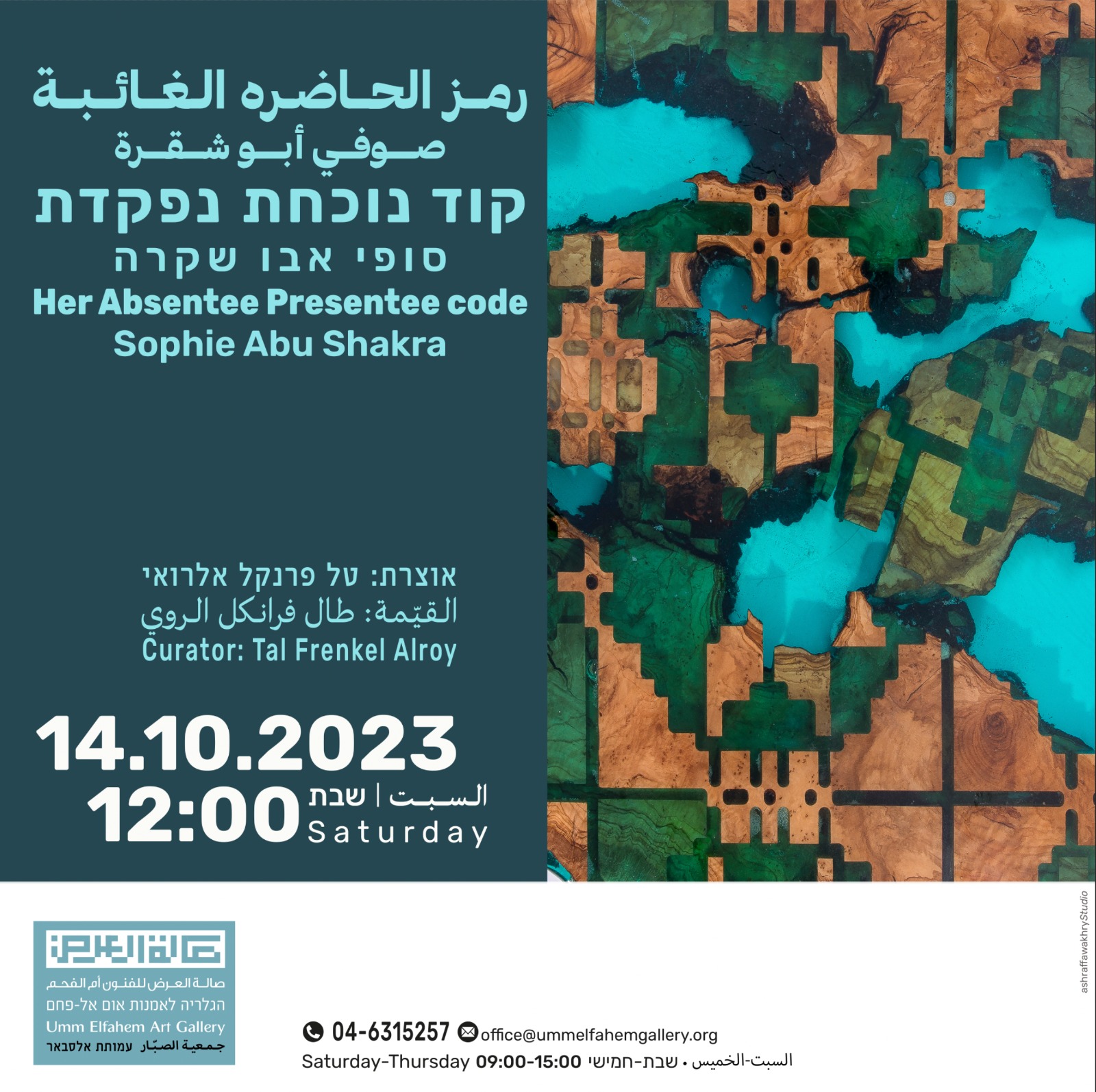
In this encounter between traditional craft and digital programming, Sophie chose to encode the cultural materials she had identified within her own family. She loaded the milling machine with images of Palestinian embroidery, which the mill then cut into the trunk of an olive tree. Embroidery and olive trees regularly feature in Palestinian culture and artisanship, including in the works of other artists from the Abu Shaqra family, where they carry symbolic meaning. Walid Abu Shaqra has commemorated the Palestinian narrative by returning to the olive tree repeatedly in his prints, whereas Farid Abu Shaqra frequently features the act of embroidery in his works.
Through the hybrid objects she created (and the accompanying video), Sophie explores the digital tools on which contemporary industrial design relies, identifying them as both a contemporary language and a form of absence. The digital code is not readily available or accessible to the audience. It is a kind of cipher or secret known only to the programmer. In this sense, it resembles the skill of Palestinian embroiderers, women who often use their craft to embed overt and covert messages into their dresses. Like the digital code, Palestinian embroidery translates symbols into meanings. The craftswomen use consistent colors and shapes to signify geographical locations, events from their family history and beliefs.
In the hybrid objects Sophie has created, the translation of the shapes of Palestinian embroidery into wood milling resonates through multiple layers of meaning. Sophie challenges the idea of the divide between local craft traditions and global technology, as well as the divide between genders. She incorporates embroidery — women’s work — into the traditionally masculine work of milling. In doing so, she disrupts the traditional division of labor and replaces it with a dialogue of many voices.
The transformation of embroidery into computer code reflects the complicated position of the designer in discussions about Palestinian tradition and women’s status. No longer a flat image, the embroidery becomes a mold: a three-dimensional, layered, almost architectural space of absence. In its new form, it depicts a topography with a double meaning: simultaneously signifying that which is there and that which is not. It becomes a hidden-yet-present code that unveils and conceals the craftswoman’s landscape, identity, tradition and hidden hand. This absent presence is emphasized through the epoxy poured onto the tree trunk. The absence is a substance — translucent, viscous, watery. It is a perpetual window into a subterranean past, a liminal space that connects knowledge passed down through generations with transient, ever-changing information.
Curated by Tal Frenkel Alroy


